Short CMO tenure is often treated as a leadership problem. The evidence suggests a more useful diagnosis: the marketing mandate has evolved faster than the organisational system supporting it.
The pattern that keeps repeating
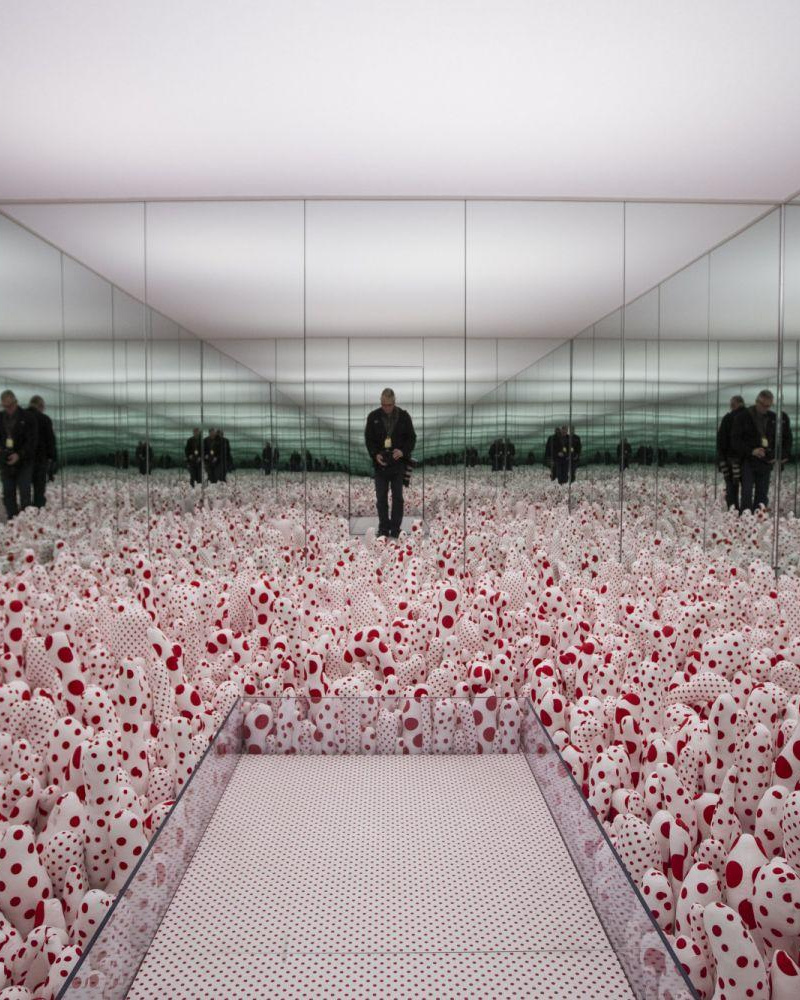
Yayoi Kusama understood the power of repetition. Organisations should also understand its danger.
Her Infinity Mirror Room, Phalli’s Field turns repetition into something that appears endless. There is a commercial analogy in the way many companies respond to instability in marketing leadership. The CMO changes, expectations rise, and a new transformation programme begins. Yet the structure underneath the role often remains largely untouched.
Artwork: Yayoi Kusama, Infinity Mirror Room, Phalli’s Field (1965).
What the tenure data actually tells us
According to Spencer Stuart’s 2026 analysis, average CMO tenure in the S&P 500 is 4.1 years, compared with 5.0 years across all C-suite roles. At the same time, 31% of S&P 500 companies operate without an enterprise CMO.
Those figures could support a familiar conclusion: the CMO role is unstable and marketing leaders struggle to meet expectations. But another finding complicates that interpretation. Of the 218 CMO exits studied between 2021 and 2025, 62% resulted in a promotion or a move into a similar or larger role.
That is not the profile of a leadership population simply failing at its job. It suggests that many capable executives are taking their experience to organisations where the conditions for success may be stronger.
Maybe short CMO tenure is not the problem. Maybe it is the symptom.
A modern mandate on top of an old system
Today’s marketing leader may be expected to build brand and future demand, influence pipeline and revenue, understand changing buyer journeys, navigate a fragmented channel environment, improve customer experience, modernise technology and decide how AI should reshape the function.
The role has become broader, more commercial and more operational. In some organisations, the title itself has changed to Chief Commercial Officer, Chief Revenue Officer or Chief Customer Officer. The label matters less than the underlying development: the boundary between marketing, sales, customer experience, data and technology is becoming harder to defend.
Yet the supporting system may still be organised around another era:
- Marketing is measured mainly through activity and campaign outputs.
- Sales and marketing operate through separate plans, data and definitions.
- Technology is added without redesigning work or decision rights.
- Teams inherit capabilities that no longer match the commercial strategy.
- New responsibilities are added, but obsolete processes rarely disappear.
This creates a structural mismatch. The executive is held accountable for an integrated commercial outcome while leading a fragmented operating model.
Changing the leader does not redesign the system
A leadership change can create energy, challenge established assumptions and bring valuable new capabilities. But it cannot compensate indefinitely for unclear ownership, conflicting incentives or an outdated operating model.
If every incoming leader encounters the same barriers, the organisation should question the environment before questioning the next appointment. Otherwise, leadership succession becomes a substitute for transformation.
The practical issue is not whether Marketing or Sales should become more powerful. It is whether the organisation has designed a coherent system for creating demand, converting it into revenue and sustaining customer value.
Five questions for the leadership team
Before redefining the CMO role or beginning another search, leadership teams should answer five operating-model questions:
- What should Marketing own? Define its accountability across brand, demand, customer insight, experience and commercial contribution.
- What should Sales own? Clarify where opportunity creation becomes opportunity conversion, and how shared outcomes will be governed.
- What should become automated? Use AI and workflow technology to remove low-value work, improve decisions and increase responsiveness.
- What should disappear? Stop reports, processes and activities that consume capacity without improving customer or commercial outcomes.
- What capabilities are needed now? Build the skills, data, technology and leadership behaviours required by the future model, not the historical structure.
These questions move the conversation away from job descriptions and towards organisational design. They also expose whether the company is genuinely prepared to support the mandate it has created.
The real test of transformation
Commercial transformation is not achieved by placing new expectations on one executive. It requires aligned ownership, measures, capabilities, incentives and ways of working across the organisation.
A strong leader can accelerate that change. But no leader can sustainably outperform the system around them.
If the mandate has changed, the operating model supporting it must change too. Otherwise, the organisation will keep replacing the person while repeating the same conditions.
Inspired by Yayoi Kusama, whose work makes the power, and danger, of repetition impossible to ignore.